REDSTONE
Creative Content Strategist assignment
The data layer for markets that no longer close.
Tempo, RedStone Live, and institutional RWAs are not separate stories. They are one category argument: payments, collateral, pricing, settlement, and risk now move continuously, so the data layer has to move continuously too.
Campaign strategy
Homepage reframe
Signal OS build
PUBLIC SURFACEREDSTONE.FINANCE

RedStone has the technical proof. The opportunity is to make the market story easier to understand, reuse, and compound.
02 - Executive read
What I found: RedStone does not need more disconnected content. It needs an operating system for proof and demand.
Found
Strong proof, scattered surfaces.
Homepage, institutional page, docs, blog posts, partner launches, clients, and case studies all carry useful proof. The market has to assemble too much of it manually.
Thesis
Own continuous finance.
The story should connect Tempo payments, RedStone Live, and institutional RWAs through one line: markets no longer close, and static data layers break under that reality.
Build
Signal OS.
A lightweight AI-assisted growth command center for source monitoring, claim governance, campaign production, case study memory, distribution, and measurement.
$6B+TVS signal
110+chains
1,300+assets
0Live downtime claim
03 - Evidence map
The raw material is already there. The deck should prove I can organize it.
HOMEPAGEORACLE CATEGORY
Credible, broad, and technical, but the first-screen market consequence can be sharper.
INSTITUTIONALRWA WEDGE
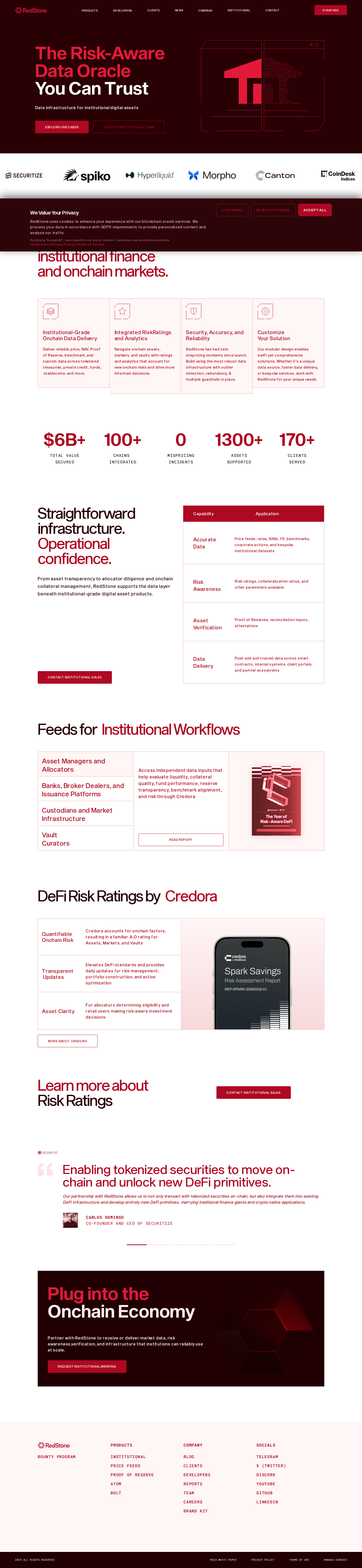
The institutional ingredients are strong: NAV, reserves, risk, market-hours metadata, proof, and buyer trust.
CASE STUDYSECURITIZE

The case study is the proof asset that should become a reusable institutional narrative system.
Sources: RedStone public homepage, institutional page, Securitize case study, RedStone Live, Tempo announcement, Canton announcement, Settle announcement, and prior audit notes.
04 - Homepage reframe
The homepage should move from oracle inventory to market consequence.
Current read
Build anything, anywhere, securely, fast.
Accurate, but broad. It describes capability before it makes the buyer feel the market problem.
→
Reframed read
The data layer behind markets that never sleep.
Specific, commercial, and extensible. It can hold payments, RWAs, perps, liquidations, and institutional collateral under one thesis.
01StreamContinuous data for markets, RWAs, payment rails, perps, and custom assets.
02VerifyRisk-aware proof for NAV, reserves, benchmarks, ratings, and audit trails.
03ActivateMake data usable in lending, collateral, liquidations, settlement, and structured products.
05 - Assignment map
The assignment becomes one operating narrative, not four isolated answers.
Task 1
Tempo x RedStone
Choose Tempo. Hook: every payment is a market event.
Task 2
RedStone Live
Momentum campaign. Hook: the closing bell is dead.
Task 3
Institutional RWA
Case study and audit. Hook: make tokenized assets usable, not just visible.
Bonus
Case study system
Turn partner proof into a reusable proof library and campaign source layer.
Unifying system:
Signal OS captures each market event, verifies the claim set, routes the buyer story, compiles the campaign, and tracks what moved after launch.
06 - Partnership campaign
Tempo is the sharper choice because payments make RedStone's market story bigger.
Core hook
Every payment is a market event.
Stablecoin rails can move value in seconds, but the financial context around that value is never static. FX changes. Collateral moves. Risk shifts. Settlement conditions matter.
AnnouncementTempo x RedStone launch narrative
X threadThe hidden market inside every payment
VisualPayment becomes price
Builder roomPayments after fixed feeds
Partner kitCo-marketing copy and proof blocks
Follow-upStablecoin rails page module
07 - Payment flow visual
Show the data path, not just the message.
01
Payment event
A transfer crosses a stablecoin payment rail.
02
Market context
FX, volatility, collateral, settlement, and risk metadata are required.
03
RedStone
Streams, verifies, signs, and routes data into the application layer.
04
Priced transfer
The payment becomes programmable, risk-aware, and institutionally legible.
BuilderIntegration proof
InstitutionRisk-aware payment rail
PartnerJoint distribution kit
SalesUse-case brief
08 - RedStone Live momentum
The closing bell is dead.
One month after launch, the campaign should stop sounding like a product update and start sounding like a market correction.
Traditional data
Market closed
Coverage pauses while on-chain positions remain active.
On-chain finance
Position active
Perps, synthetics, liquidation engines, and RWA products need continuous state.
RedStone Live
Feed live
Continuous data turns off-market coverage into a product advantage.
Data story
Use-case deep dive
Builder proof
Momentum thread
Partner amplification
09 - Institutional audit
Make tokenized assets usable, not just visible.
INSTITUTIONAL PAGERWA PATH
The page has the proof. The conversion path should route by institutional job.
01
Lead with consequence.
Tokenized assets cannot become collateral until pricing, reserves, and settlement are verifiable under stress.
02
Route by buyer job.
Issuers, allocators, lending protocols, and market operators care about different failure modes.
03
Move proof into the decision path.
Securitize, Morpho, Pendle, TVS, chains, and uptime should become conversion architecture.
10 - Fictional case study
How a tokenized credit platform turned static NAV into usable collateral.
Challenge
Atlas Credit Markets had borrower demand and DeFi lender interest, but NAV updates were too slow for protocol integrations, and liquidation paths were unclear.
Solution
RedStone turned administrator NAV, reserves, market-hours metadata, and redemption constraints into signed, auditable on-chain inputs.
Outcome
The asset moved from "on-chain" to "at work": priced, monitored, and integrated without pretending tokenized credit trades like ETH.
Administrator data
Risk metadata
RedStone feed
Lending protocol
Usable collateral
11 - Case study strategy
Case studies should become RedStone's proof library, not isolated blog posts.
Proof assetAudienceMarket storyReusable output
SecuritizeIssuers + DeFi protocolsTokenized funds become usable in DeFiRWA utility hub
Felix / LivePerps + synthetic marketsLaunch markets others cannot priceLive market desk series
Settle / RWA curatorVault curators + allocatorsSettlement and liquidation under stressRisk infrastructure case
TempoPayment builders + stablecoin appsEvery transfer carries market contextPayment rails narrative
12 - What I would build
RedStone Signal OS
A lightweight AI-assisted operating layer for turning RedStone launches, product releases, market signals, partner proof, and case studies into repeatable growth infrastructure.
Signal radar
Claims ledger
Narrative router
Campaign compiler
Case study pipeline
Distribution tracker
13 - Build architecture
A connected workflow, not an "AI content calendar."
01SourcesBlog, docs, product pages, partners, X, GitHub/docs changes, competitors, RWA news.
02IngestionScheduled jobs normalize new signals and classify audience, market, urgency, and proof dependency.
03MemoryPostgres plus pgvector stores sources, claims, campaigns, personas, prompts, and history.
04AI layerOpenAI or OpenRouter summarizes, compares, drafts, flags risks, and prepares structured briefs.
05ReviewI choose the angle, verify claims, tune copy, route the audience, and approve what ships.
06DashboardLeadership sees campaign status, proof readiness, partner distribution, and growth traction.
14 - Dashboard preview
What leadership would actually see.
Signal radar
Tempo payments launch
High urgency. Routes to builders, partner channels, institutional payments, and stablecoin app audiences.
PaymentsFXRiskPartner
Claims ready14Approved proof blocks for this campaign.
Assets queued9Thread, page module, webinar, founder post, partner kit.
Distribution72%Coverage across owned, partner, founder, and sales channels.
Growth signal+31%Engagement lift across RWA, Live, and payments cluster.
Next action
Convert Tempo into a stablecoin rails page section.
Inputs: Tempo announcement, RedStone Live proof, FX/risk messaging, partner quote request, technical review.
15 - Proposed stack
The build should stay lightweight, inspectable, and close to how technical teams already ship.
FrontendNext.js / ReactInternal dashboard, campaign views, proof library, and previewable campaign modules.
HostingVercelFast previews, secure internal access patterns, scheduled jobs, and simple deployment.
DatabaseNeon or Supabase PostgresSignals, claims, campaigns, partners, assets, source links, owners, and status history.
MemorypgvectorSearchable context from docs, blog posts, partner launches, claims, and prior campaigns.
AI layerOpenAI / OpenRouterSummaries, narrative variants, competitor synthesis, claim checks, and editorial QA.
AutomationVercel Cron / GitHub ActionsSource checks, freshness reminders, claim review tasks, and distribution follow-ups.
16 - Growth tracking
The dashboard should track narrative traction, not vanity activity.
OwnedPages, docs, blog, case studiesTraffic, scroll depth, CTA clicks, search impressions, internal reuse.
PartnerTempo, Securitize, Canton, SettleCo-marketing coverage, quotes, reposts, partner-side content, joint rooms.
SocialX, founder posts, ecosystem channelsEngagement quality, saves, replies, quote posts, audience overlap, narrative pickup.
Revenue signalCRM if availableQualified conversations, briefing requests, integration intent, sales enablement use.
Market signal
Campaign asset
Distribution event
Engagement
Qualified conversation
17 - How I would operate
I would sit between technical infrastructure and market understanding.
Content operator
Own the system.
Maintain the claims ledger, launch calendar, source library, campaign queue, and proof governance.
Growth architect
Build the engine.
Connect sources, memory, AI-assisted briefing, review gates, dashboard surfaces, and measurement loops.
Strategist
Ship the story.
Turn technical releases into narrative, visual concepts, buyer routes, partner kits, and conversion assets.
The role is not only writing. It is building and operating the system that turns RedStone's proof into market belief.
18 - Close
This is the work I would bring into RedStone full-time.
A public campaign surface, a strategy deck, and a locked Signal OS preview are the proof of work. The deeper value is the operating habit behind them: technical translation, source-backed claims, sharp positioning, AI-assisted execution, and polished shipping.
Prepared by
José Oramas
